Artificial Turf Maintenance Science in North Texas (How Maintenance Extends Turf Performance)
Artificial turf requires less maintenance than natural grass.
However, synthetic turf still needs professional care to maintain long-term performance.
Many homeowners believe turf requires zero maintenance.
That assumption often leads to premature turf wear and performance decline.
North Texas environmental conditions place additional stress on turf systems.
Heat, clay soil movement, and storm debris accelerate maintenance demands.
Maintenance protects drainage efficiency, fiber integrity, and infill stability.
Proper care dramatically extends turf lifespan.
Understanding turf maintenance science helps homeowners protect their investment.
You can explore our complete system design approach on our Artificial Turf Systems page.

Why Artificial Turf Requires Maintenance
Artificial turf performs as a layered system, not a single surface.
Each layer requires protection to maintain system performance.
Traffic compacts infill and reduces fiber support structure.
Organic debris blocks drainage pathways and traps moisture.
Dust accumulation reduces turf realism and accelerates fiber abrasion.
Pet waste contamination introduces bacteria and odor development risks.
North Texas windstorms deposit heavy organic debris onto turf surfaces.
Summer heat increases bacterial growth rates within infill layers.
Routine maintenance prevents structural performance decline.
Maintenance preserves visual realism and comfort underfoot.
The Role of Infill in Turf Performance
Infill material supports turf fiber posture and surface stability.
Infill also regulates drainage and temperature performance.
Traffic compacts infill into dense layers beneath turf fibers.
Compacted infill reduces shock absorption and increases fiber stress.
Infill migration creates uneven turf surfaces and visible depressions.
Uneven surfaces increase seam stress and drainage inconsistencies.
Periodic infill redistribution restores surface stability.
Proper infill depth protects turf fibers from premature fatigue.
Our Turf Lifespan guide explains how infill stability affects long-term durability.
Power Brushing and Fiber Restoration
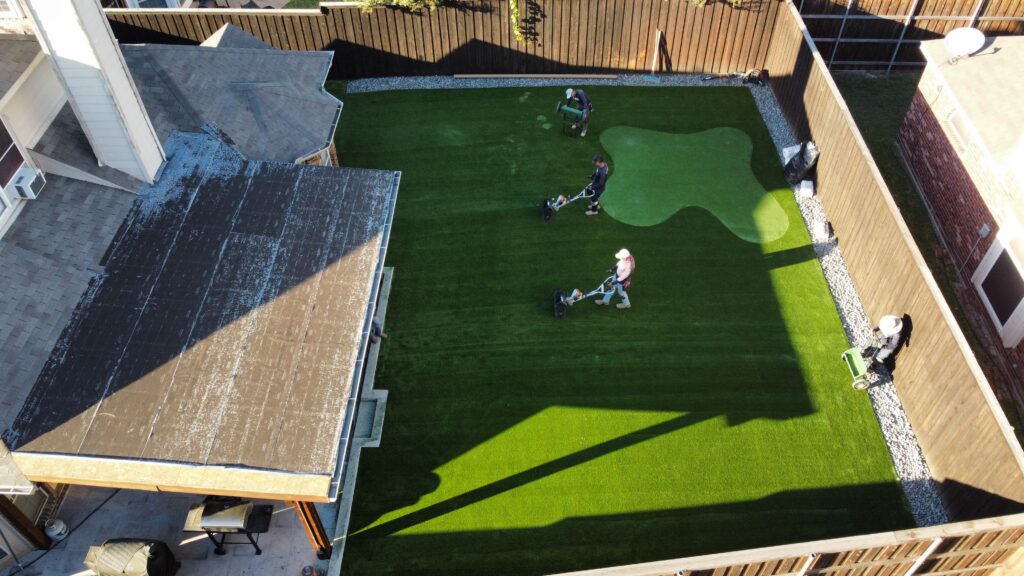
Power brushing restores turf fiber posture and redistributes infill material.
Brushing prevents turf fibers from matting under repeated traffic.
Professional power brooms lift compressed fibers back into upright positions.
Brushing also loosens compacted infill layers.
Regular brushing maintains turf realism and improves drainage flow.
Brushing prevents permanent fiber folding and memory loss.
North Texas turf installations often experience accelerated fiber matting due to heavy summer use.
Regular brushing dramatically slows fiber deterioration.
Proper brushing techniques vary based on turf fiber type and stitch density.
Incorrect brushing can damage lower-quality turf products.
Debris Removal and Drainage Preservation
Drainage performance directly affects turf longevity and sanitation.
Organic debris blocks drainage perforations within turf backing.
Blocked drainage traps moisture and promotes bacterial growth.
Standing moisture accelerates backing material breakdown.
Leaf accumulation commonly occurs during North Texas storm seasons.
Wind-driven debris often collects along hardscape edges and fences.
Routine debris removal preserves drainage capacity and prevents odor development.
Maintenance crews inspect drainage performance during service visits.
Our Artificial Turf Drainage guide explains how water flow protects turf systems.
Pet Turf Sanitation Science
Pet turf requires specialized sanitation procedures beyond visual cleaning.
Urine introduces bacteria that settle within infill layers.
Moisture retention within infill promotes bacterial growth and odor formation.
Sanitation flushing removes contaminants from drainage layers.
Professional enzyme treatments neutralize organic odor compounds.
Routine flushing preserves drainage performance and surface hygiene.
High pet traffic areas require increased sanitation frequency.
Maintenance planning should reflect pet activity patterns.
Our Turf for Dogs and High Traffic Areas guide explains installation design for pet durability.
Seasonal Maintenance Considerations in North Texas
North Texas climate creates seasonal maintenance demands for turf systems.
Summer heat accelerates bacterial growth and fiber stress exposure.
Fall storms deposit heavy leaf debris across turf installations.
Winter temperature swings stress seam integrity and backing flexibility.
Spring pollen accumulation reduces surface drainage efficiency.
Spring storms often reveal drainage performance weaknesses.
Professional maintenance schedules adapt to seasonal environmental conditions.
Seasonal inspections detect early performance issues before failure occurs.
We have observed these seasonal maintenance patterns across properties in Celina, Prosper, Westlake, and Southlake installations.
Seam Preservation Through Maintenance
Seams represent the most vulnerable structural connection within turf systems.
Infill compaction increases seam stress under traffic loads.
Debris buildup traps moisture along seam edges.
Moisture weakens adhesives and seam tape bonding strength.
Routine brushing distributes traffic stress evenly across seams.
Seam inspections detect early separation before structural failure occurs.
Our Turf Seam Visibility guide explains seam engineering and failure causes.
Maintenance Frequency Guidelines
Maintenance frequency varies based on property usage and environmental exposure.
Low-traffic residential lawns require maintenance several times per year.
Pet turf installations require sanitation flushing multiple times annually.
High-use recreation areas require more frequent brushing and infill redistribution.
Commercial turf installations often require monthly maintenance programs.
Maintenance planning should reflect traffic volume and debris exposure.
Professional inspections identify performance changes before visible surface decline occurs.
Maintenance documentation helps homeowners track turf performance over time.
How Maintenance Extends Turf Lifespan and Investment Value
Proper maintenance directly increases artificial turf lifespan.
Maintenance preserves fiber strength and backing stability.
Routine care reduces long-term replacement costs.
Maintained turf retains visual realism and surface comfort.
Homeowners who follow maintenance programs consistently achieve longer turf service life.
Maintenance protects property value and outdoor usability.
Understanding maintenance science allows homeowners to maximize turf investment returns.
Professional maintenance ensures turf systems perform as designed.

Professional Turf Performance Inspections
Artificial turf performance gradually changes over time.
Many performance issues begin beneath the visible surface.
Professional turf inspections evaluate structural and drainage performance conditions.
Inspections identify early warning signs before visible turf damage appears.
Technicians inspect infill depth consistency across traffic zones.
Uneven infill often signals drainage disruption or traffic compaction.
Inspection teams evaluate seam integrity and adhesive stability.
Seam inspections detect early separation or backing stress movement.
Drainage testing verifies vertical water flow performance beneath turf surfaces.
Drainage inspections often reveal debris buildup inside base layers.
Technicians also evaluate turf fiber memory and structural resilience.
Fiber fatigue usually appears before visual matting becomes obvious.
Professional audits assess base stability beneath high traffic zones.
Base movement often causes surface undulation and seam tension.
Homeowners rarely notice subsurface performance decline during early stages.
Early detection reduces long-term repair and replacement costs.
Properties with heavy use benefit from routine performance inspections.
Pet turf installations especially benefit from sanitation and drainage testing.
We frequently perform turf performance audits across high-traffic residential installations.
These evaluations help homeowners in communities such as Celina, Prosper, Westlake, and Southlake maintain long-term turf performance.