
Why Artificial Turf Seams Show Over Time
Visible seams represent one of the most common artificial turf complaints.
They rarely result from turf quality alone.
Seams show because installation shortcuts were taken.
Layout planning, base preparation, and seam construction determine long-term appearance.
Many homeowners assume seams appear naturally with age.
That assumption protects poor installation practices.
We see this misconception most often in North Texas communities like Celina, Prosper, Westlake, and Southlake, where climate, clay soil, and yard usage patterns quickly expose installation shortcuts.
Properly installed turf seams should remain invisible for years.
When seams show early, something went wrong during installation.
This page explains why turf seams fail and how professional systems prevent those failures.
What a Turf Seam Actually Is
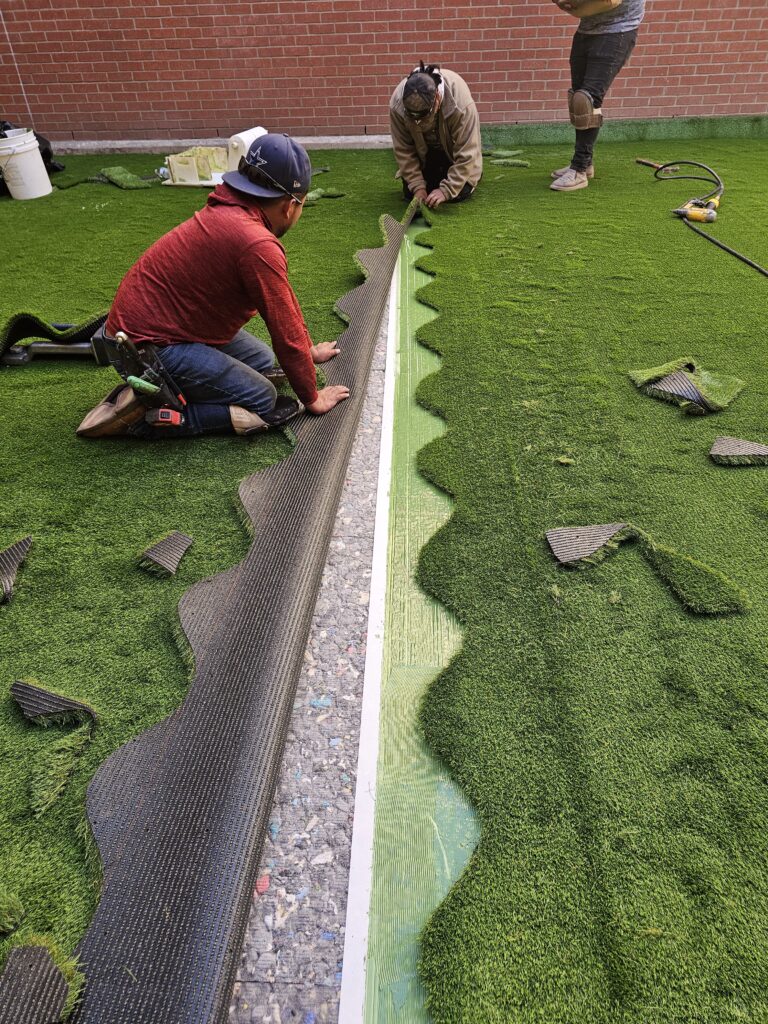
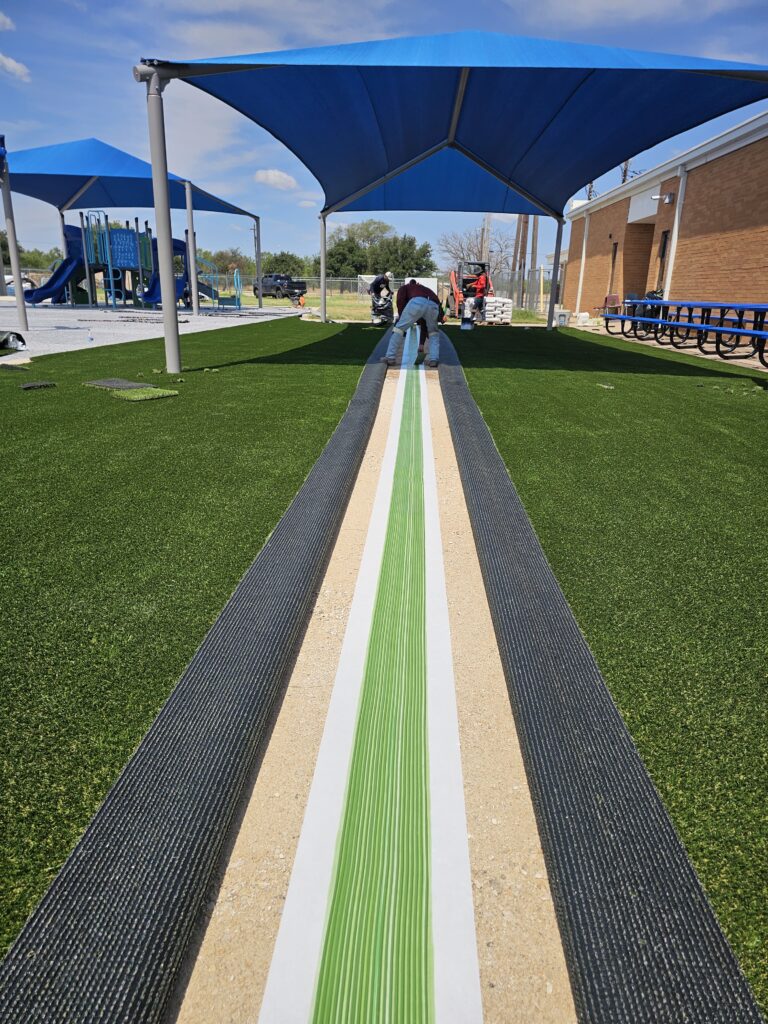
A turf seam joins two rolls of artificial grass.
Each roll contains fibers woven in one direction.
Installers must align fiber direction perfectly across the seam.
They must also bond the backing securely underneath.
Seams rely on adhesive strength, surface tension, and base stability.
Failure in any area creates visible separation.
Seams do not fail randomly.
They fail predictably when systems ignore physics and material behavior.
Mistake #1: Poor Layout and Fiber Direction Planning
Artificial turf fibers reflect light differently by direction.
Improper alignment creates shading differences across seams.
Inexperienced installers prioritize material efficiency over visual consistency.
As a result, mismatched panels get installed.
This approach creates unnatural shading and visible roll transitions.
Even premium turf cannot hide poor layout planning.
Professional installers plan fiber direction before cutting begins.
They maintain uniform appearance across the entire surface.
Mistake #2: Improper Seam Placement
Seams should avoid high-traffic zones whenever possible.
Traffic increases stress and movement over time.
Many installations place seams where rolls happen to meet.
Those locations ignore use patterns entirely.
Seams placed near slopes or drainage paths fail faster.
Water movement and compaction amplify separation.
Professional layouts place seams strategically.
They minimize exposure to stress and directional forces.
Mistake #3: Inadequate Seam Adhesive Application
Seam tape requires full adhesive coverage.
Partial bonding creates weak points.
Some installers rush adhesive application to save time.
Others underapply to reduce material costs.
Inconsistent adhesive thickness leads to uneven curing.
That inconsistency allows edges to lift.
Proper seam bonding requires measured adhesive coverage.
Curing time must remain uninterrupted.
Mistake #4: Skipping Proper Base Compaction at Seams
Seams magnify base failures.
Even minor settling becomes visible at seam lines.
Some installers compact the field but ignore seam zones.
That shortcut creates uneven support.
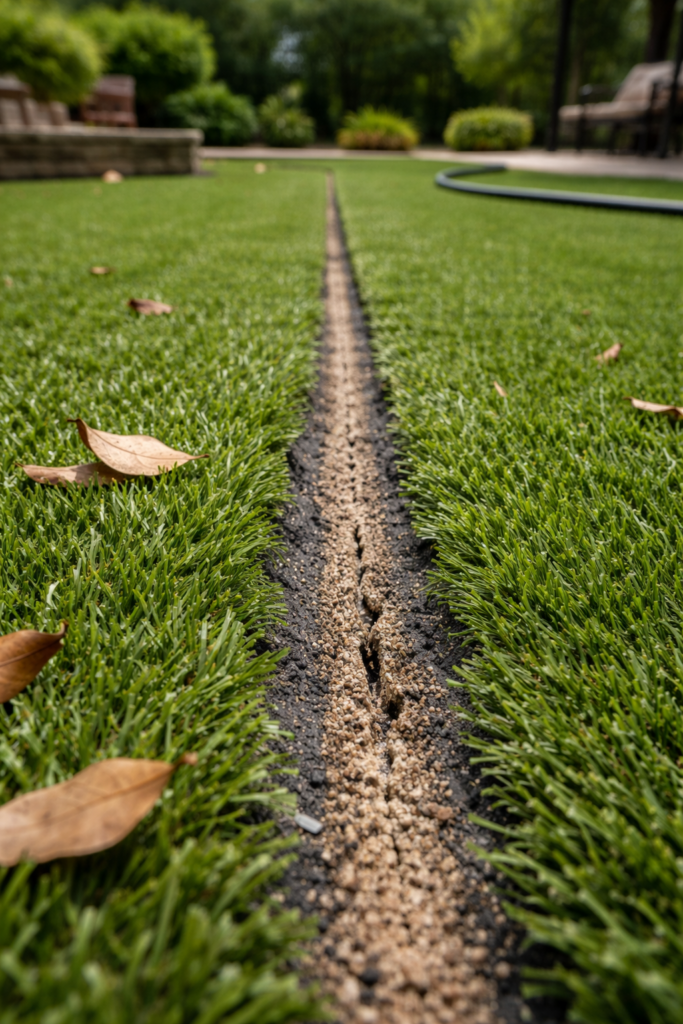
As the base shifts, seams separate.
The turf itself simply follows the movement.
Professional systems compact base layers uniformly.
They verify density before seam installation.
Mistake #5: Ignoring Drainage Behavior at Seams
Water follows the path of least resistance.
Seams often become those paths.
Without proper drainage planning, water saturates seam areas.
Saturation weakens adhesive bonds.
Repeated wetting and drying accelerates separation.
This problem worsens in North Texas clay soils.
Professional installations evaluate drainage paths early.
They redirect water away from seam zones.
Mistake #6: Treating All Turf Systems the Same
Not all turf installations face identical demands.
Traffic, slope, and usage vary by zone.
Using one seam method across every area invites failure.
High-traffic zones require stronger reinforcement.
Pet areas and playgrounds stress seams differently.
Pool surrounds introduce heat and moisture challenges.
Professional installers adapt seam methods by use case.
System design changes based on load and exposure.
Learn more about the other common artificial turf mistakes and how to avoid them HERE.
Why Seams Often Show Months After Installation
Seams rarely fail immediately.
They reveal themselves after environmental stress.
Heat expansion causes turf backing to move.
Poorly bonded seams cannot resist that movement.
Rainfall tests drainage design repeatedly.
Base saturation exposes weak compaction.
Traffic compounds small issues into visible separation.
What starts hidden eventually becomes obvious.
Delayed failure does not mean delayed responsibility.
It confirms flawed installation choices.
Why “Premium Turf” Does Not Guarantee Invisible Seams
Turf quality influences fiber resilience and appearance.
It does not correct installation errors.
Premium turf still relies on seam integrity.
Poor adhesive application defeats expensive materials.
Many homeowners confuse product specifications with system performance.
That confusion benefits low-quality installers.
Professional results come from process control.
Materials only support the process.
Learn more about budget vs premium artificial turf HERE.
How Professional Turf Systems Prevent Seam Failure
Professional systems treat seams as structural components.
They receive special attention during installation.
Installers plan seam layout during the design phase.
They account for traffic, drainage, and slope.
Base preparation extends uniformly beneath seams.
Compaction verification occurs before bonding.
Adhesive application follows measured standards.
Curing time remains protected from disturbance.
This process prevents visible seams long term.
Learn more about our artificial turf systems at OhMyYard HERE.
How to Evaluate Seam Quality Before Hiring a Contractor
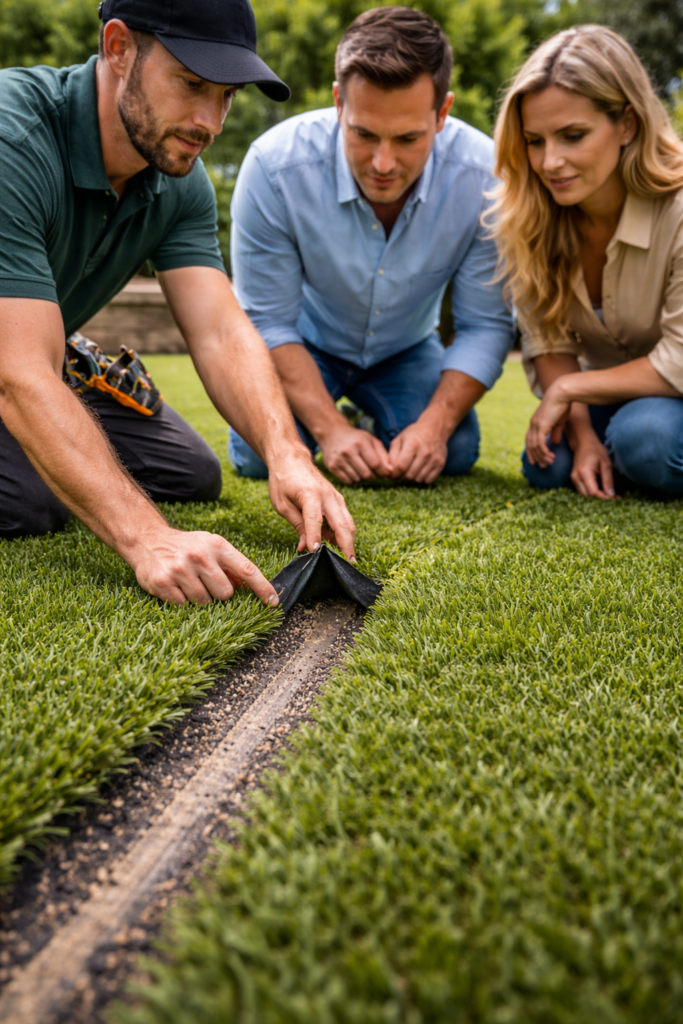
Ask how fiber direction gets planned.
Request examples showing uniform shading.
Ask where seams will be placed.
Verify those locations avoid stress zones.
Ask how base compaction gets verified.
Vague answers signal risk.
Ask about adhesive type and coverage method.
Professional installers explain their process clearly. (See ours HERE)
If answers feel minimized, risk shifts to the homeowner.
Why Seam Failures Increase Long-Term Cost
Visible seams reduce aesthetic value immediately.
They also signal deeper system problems.
Homeowners often attempt spot repairs.
Those repairs rarely hold.
Seam failure usually requires partial or full replacement.
Replacement costs exceed initial savings.
Proper installation costs less over the system’s lifespan.
Seams play a major role in that equation.
Seams Reflect Installation Quality, Not Turf Age
Artificial turf seams do not fail naturally.
They fail because systems ignore fundamentals.
Uniform appearance depends on planning, preparation, and execution.
Shortcuts surface over time.
Homeowners should view seams as indicators.
They reveal whether the system was built correctly.
Professional turf systems keep seams invisible.
Anything less signals compromised installation.